
Did you know that curtains are one of the most underrated tools in daylight photography? They soften, direct, and shape light in a way no lamp ever could. In the daylight studios at Atelier Oost Amsterdam—with their tall windows and carefully chosen curtains—this is daily practice. In our insiders’ guide, you’ll learn how to work with curtains like a professional and why they’re indispensable in any serious production.


What curtains do to daylight (and why it works)
Curtains are living light modifiers. They move, breathe, and respond to daylight throughout the day. While a softbox is static, curtains are dynamic. They soften harsh sunlight, break up contrast, and create depth without feeling artificial. In our studios, you see it instantly: close a curtain halfway, and the light changes from direct to soft and diffused. Open it again, and you get direction, shadow, and character.
Here’s why you must use curtains on your next shoot:
They create magically beautiful images when combined with daylight They add atmosphere without looking artificial They force you to observe your scene more consciously They’re versatile—perfect for everything from cinematic to clean, minimal shots
Here’s why you must use curtains on your next shoot:

Curtains as a natural light director
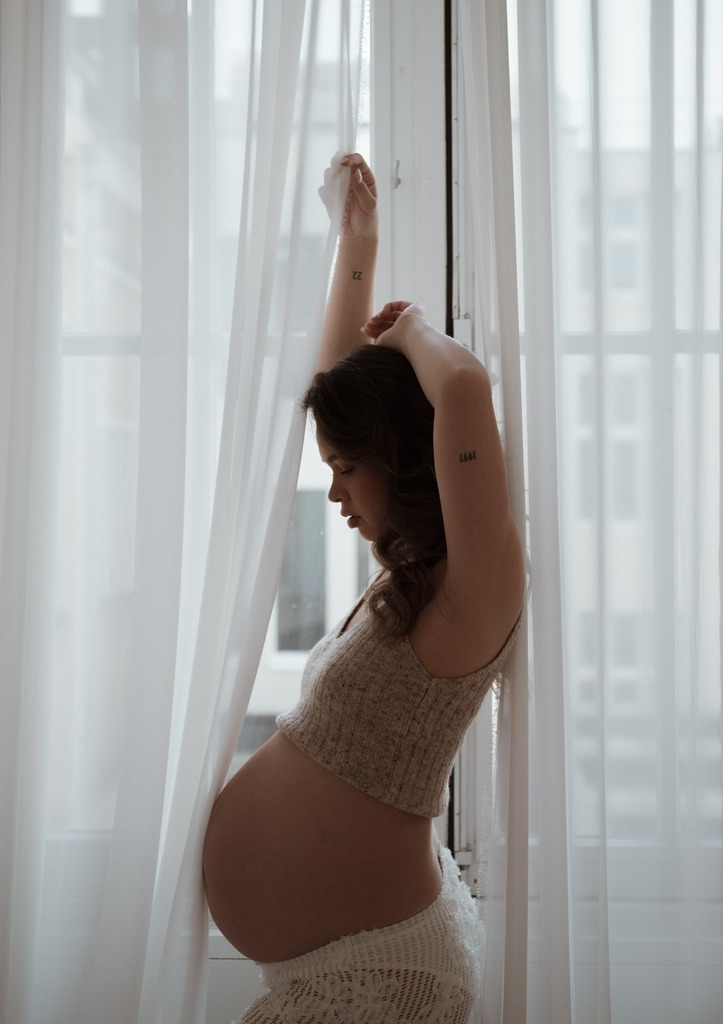
Pssst… an insider tip you’ll rarely read elsewhere: use curtains not just to block light, but to place it. By closing one curtain slightly more than the other, you can create subtle light fall across a face or body. The result? Naturally Rembrandt-worthy lighting, without a single lamp. More tips:
Leave 5–15 cm of space between the curtain and the window
Avoid closing the curtain completely. A narrow opening creates a soft light strip that beautifully highlights faces, shoulders, or jawlines Use the folds of the curtain as light blockers.
Position your model so a fold falls across part of the face—it acts as a flag, reducing contrast without extra tools. Position your model at a 30–45° angle to the window, not parallel.
This creates uneven light across the body, adding depth, form, and character instead of flat lighting.
Pssst… an insider tip you’ll rarely read elsewhere: use curtains not just to block light, but to place it. By closing one curtain slightly more than the other, you can create subtle light fall across a face or body. The result? Naturally Rembrandt-worthy lighting, without a single lamp. More tips:
Avoid closing the curtain completely. A narrow opening creates a soft light strip that beautifully highlights faces, shoulders, or jawlines
Position your model so a fold falls across part of the face—it acts as a flag, reducing contrast without extra tools.
This creates uneven light across the body, adding depth, form, and character instead of flat lighting.
Which photography thrives in curtain light?
Curtains work best when you want to leave room for feeling. They’re perfect for portraits with character, editorial and fashion shoots with a cinematic vibe, and branding shoots that focus on personal stories. In boudoir photography curtains add a layer of intimacy and calm. Even in product photography , we’re fans: still lifes gain depth, softer shadows, and a timeless aesthetic.
Curtains work best when you want to leave room for feeling. They’re perfect for portraits with character, editorial and fashion shoots with a cinematic vibe, and branding shoots that focus on personal stories. In boudoir photography curtains add a layer of intimacy and calm. Even in product photography , we’re fans: still lifes gain depth, softer shadows, and a timeless aesthetic.


Poses that work with curtains
Try moving your subject or object slightly away from the window and experiment with:
Leaning against the curtain Touching or holding the fabric Partially disappearing behind it
Movement is key. Curtains give you something to play with—literally. A small turn of the body instantly changes the light on skin and face. Insider tip: ask your model to move slowly while you shoot. Curtains react subtly, producing unexpected moments.
Movement is key. Curtains give you something to play with—literally. A small turn of the body instantly changes the light on skin and face. Insider tip: ask your model to move slowly while you shoot. Curtains react subtly, producing unexpected moments.


Technical tips that make a difference
Daylight and curtains demand finesse, not brute force. Our favourite technical guidelines:
Prefer a slightly higher ISO over harsh contrast Use a wide aperture (f/1.8 – f/2.8) for softness Slightly underexpose to preserve highlights Set your white balance manually for consistency
And perhaps most importantly: trust your histogram, but follow your instincts.
Timing matters. Don’t just plan your shoot around availability—plan it around light behaviour. In our studios, curtains react differently depending on the sun’s position. In the morning, light is fresh and often direct; curtains soften and direct it for crisp, clean images. Around midday, light becomes more diffuse and even, producing a soft, flattering effect when paired with curtains. By late afternoon, daylight gains direction and warmth—ideal for layered, cinematic shots.
Daylight and curtains demand finesse, not brute force. Our favourite technical guidelines:
And perhaps most importantly: trust your histogram, but follow your instincts.
Timing matters. Don’t just plan your shoot around availability—plan it around light behaviour. In our studios, curtains react differently depending on the sun’s position. In the morning, light is fresh and often direct; curtains soften and direct it for crisp, clean images. Around midday, light becomes more diffuse and even, producing a soft, flattering effect when paired with curtains. By late afternoon, daylight gains direction and warmth—ideal for layered, cinematic shots.
Why curtains are essential in daylight photography
Atelier Oost Amsterdam is all about daylight that works. Our tall windows and carefully chosen curtains aren’t just decorative—they’re tools to shape light rather than force it. They invite you to slow down, look differently, and work with what’s already there. Photographers often experience the same thing: very little is needed to create a strong image. And that’s precisely the point. Working with curtains teaches an essential principle of photography: good light doesn’t have to dominate—it supports and creates space. Once mastered, it changes the way you see daylight forever.